


World Ethics Institute Beijing (WEIB), Peking University
“Artificial Intelligence and Applied Ethics” (AIAE) Program
The AIAE Program is an academic initiative established by the Center to expand the boundaries of the humanities and respond to the trends of our time. It seeks to build a dialogue platform between the humanities and the field of artificial intelligence, with the aim of exploring a form of humanistic AI that serves the common good economy. At the same time, the program endeavors to foster innovation in applied ethics through multi-level cooperation and exchange, and to lay an ethical foundation for AI that truly benefits the public good. Together with other research projects under the Center—such as “Spiritual Humanism,” “The Discourse on the Ru Merchant,” and “Confucian Business and Corporate Ethics”—the AIAE Program is committed to advancing the development of the humanities.
Dr. Stephan Rothlin
CEO, Rothlin International Management Consulting, Ltd.
Director, AIAE Program of the World Ethics Institute Beijing (WEIB), Peking University (Part-time)
Contact us: aiae_weib@pku.edu.cn
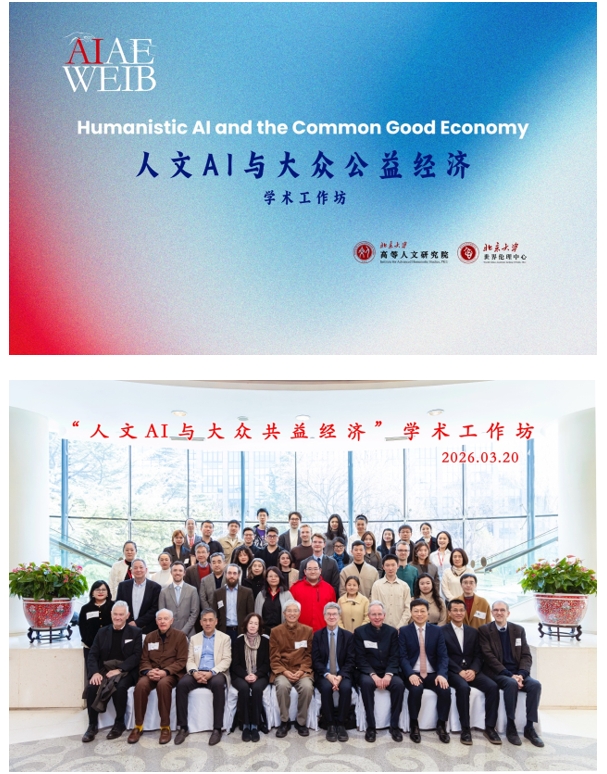
Workshop on “Humanistic AI and the Common Good Economy”
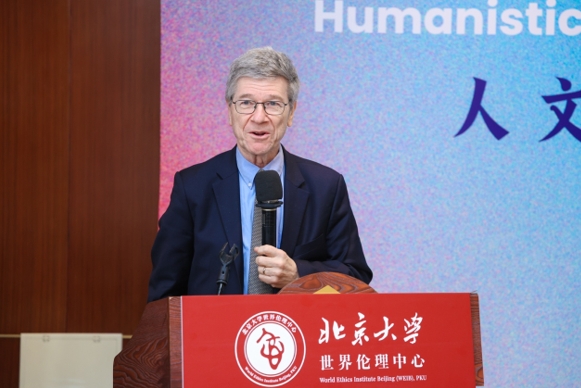
On March 20, 2026, the Artificial Intelligence and Applied Ethics (AIAE) Program of the World Ethics Institute Beijing (WEIB), Peking University, held an academic workshop in Beijing titled “Humanistic AI and the Common Good Economy.” Professor Jeffrey Sachs, Professor at Columbia University and President of the UN Sustainable Development Solutions Network, was invited to deliver a keynote speech. He noted that the lack of a shared understanding of the concept of the “Common Good” across different sectors is one of the gravest challenges the world faces today. Tracing the history of Western political philosophy, Professor Sachs critiqued the Anglo-American tradition represented by Hobbes and Locke for reducing politics to “power management” and “property protection,” which has led modern societies to neglect, or even reject, the Common Good, instead pursuing endless competition for power.
Professor Sachs drew an analogy between AI technology and the steam engine of the 19th century, emphasizing that AI will not only dramatically enhance productivity but also reshape human social structures and ways of life. He argued that issues triggered by AI—such as extreme concentration of wealth and military applications—will continue to exacerbate social inequality and threaten global security and stability.
The workshop brought together Professor Cheng Lesong, Chair of the Department of Philosophy at Peking University; Professor Yao Xinzhong, Professor at the School of Philosophy, Renmin University of China and Executive Director of the World Ethics Institute Beijing (WEIB); Stephan Rothlin, CEO of Beijing Roshili International Management Consulting Co., Ltd. and Director of the AIAE Program at WEIB; Professor Bernard Lee from Saint Francis University, Hong Kong; Veronika Saraswati, Director of the China Studies Center at the Centre for Strategic and International Studies (CSIS) Indonesia; as well as young scholars from Peking University’s Yenching Academy and Tsinghua University’s Schwarzman College. Together, they engaged in in-depth discussions on how to build a new economic paradigm that serves the well-being of all humanity in the age of artificial intelligence.
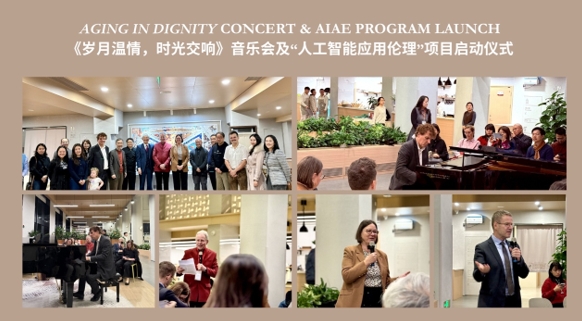
Launch Ceremony of the AIAE Program Held as a Concert: “Warmth of Time, Symphony of Years”
The launch ceremony of the Artificial Intelligence and Applied Ethics (AIAE) Program of the World Ethics Institute Beijing (WEIB), Peking University, was held in the form of a concert under the theme “Aging in Dignity” This event underscored one of the core missions of the AIAE Program: to confront the crisis of filial piety in an aging society, and to explore the future of applied ethics against the backdrop of the “Age of Aging” and the deep integration of artificial intelligence into energy, chips, and infrastructure.
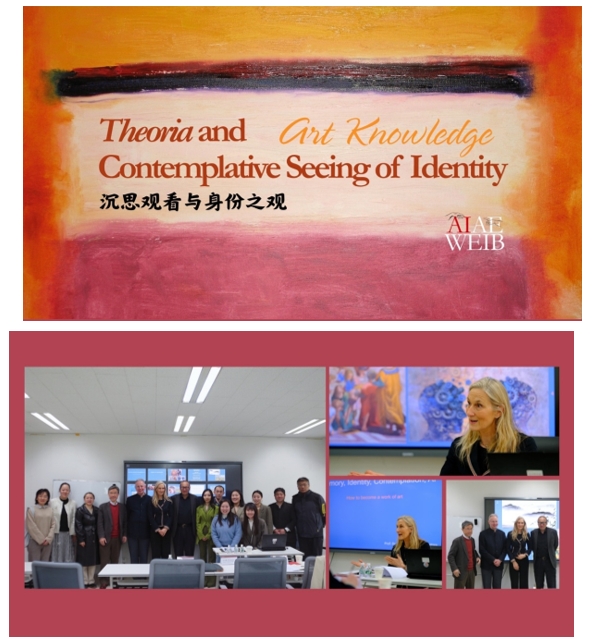
April 8, 2026 – Professor Yvonne Dohna Schlobitten, Professor of Philosophy and Theory of Sacred and Artistic Spirituality at the Pontifical Gregorian University in Rome, was invited to deliver a lecture series at the Institute for Advanced Humanistic Studies, Peking University, under the title “Art as Knowledge: Theoria and the Vision of Identity.”
The first lecture revisited the classical concept of Theoria, reflecting on the crisis of thought in modern science. It advocated for a contemplative mode of seeing as a way to open up new perspectives on identity, and proposed understanding works of art as spaces where one encounters identity.
The following day, the second lecture, titled “Identity, Memory, and the Limits of Artificial Intelligence,” took place. Through discussions of works by Paul Cézanne, J. M. W. Turner, Claude Monet, and Marina Abramović, Professor Yvonne Dohna Schlobitten elaborated on her reflections on the role of art in the process of identifying the self, art as a form of participation in nature and creation, and contemplative seeing as a path to knowledge.


Copyright@2014北京大学高等人文研究院 京ICP备案1253235 地址:北京市海淀区颐和园路五号北京大学李兆基人文学苑4号楼 技术支持:iWing